Dump Truck Dispatcher vs Truckbase: 2026 comparison

Truckbase is the stronger choice for small-to-midsize freight carriers that prioritize fast setup, broker and BOL workflows, and broad ELD connectivity. Dump Truck Dispatcher is the broader choice for aggregate and dump-truck operations, especially when teams need recurring short-haul dispatch, ticket-to-invoice workflows, subcontractor coordination, DOT requirement tracking, and vehicle maintenance.
Schedule a demo
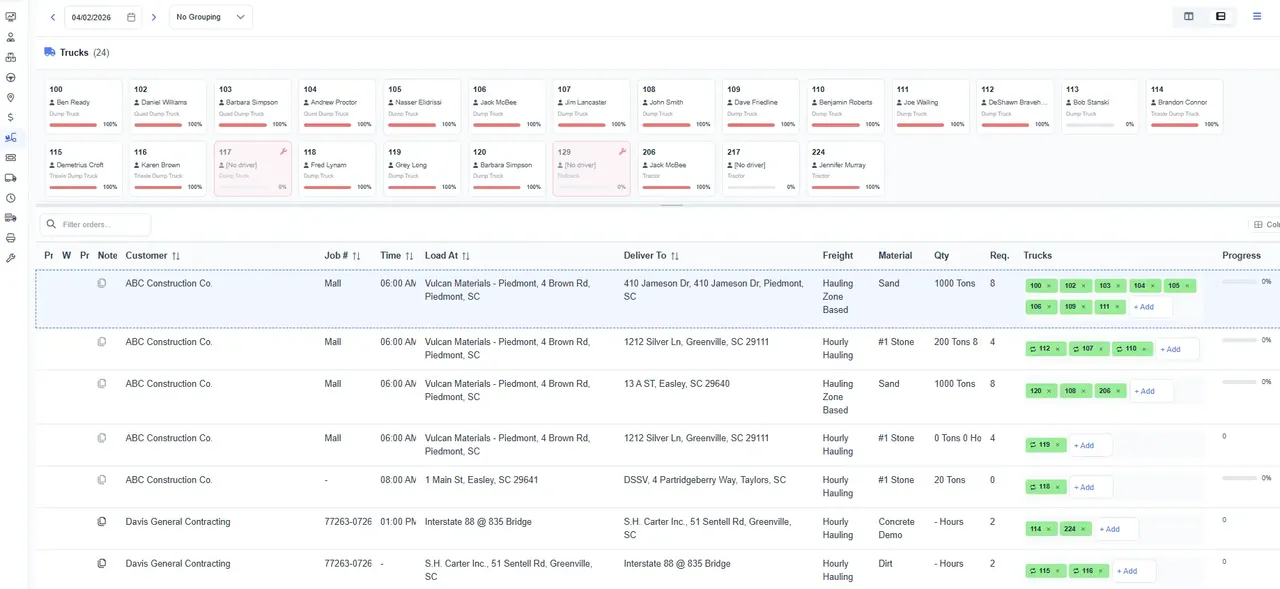
Dump Truck Dispatcher scheduling board showing truck assignments

Dump Truck Dispatcher and Truckbase at a glance

Both products connect dispatch to back-office work. The important difference is whether the operation runs on aggregate tickets and repeated short-haul movements or conventional freight loads and BOLs.

CriterionDump Truck DispatcherTruckbaseBottom line
Best fitAggregate haulers and dump-truck companiesSmall-to-midsize asset-based freight carriersStart with what the fleet hauls and how work is billed.
Dispatch modelRecurring short-haul orders, bulk reassignment, equipment types, and mixed company and lease-hauler fleetsLoad calendar, AI-assisted load import, text or email dispatch, and broker updatesTruckbase fits conventional freight loads; Dump Truck Dispatcher fits repeated aggregate movements.
Field documentsDigital load tickets, ticket details, signatures, and missing or duplicate ticket controlsBOL scanning, mobile document upload, and broker or customer document updatesThe source document follows the operating model: tickets for aggregate, BOLs for freight.
InvoicingTicket verification, high-volume batch invoicing, and QuickBooks Desktop or CSV exportRate-confirmation and BOL invoicing, AR tracking, factoring emails, and QuickBooks Online syncBoth connect dispatch to billing around different operating records.
Driver and outside-carrier payDriver pay, subcontractor pay statements, and lease-hauler workflowAutomated driver settlements for company drivers and owner-operatorsDump Truck Dispatcher extends the workflow to subcontracted hauling companies.
IntegrationsQuickBooks export plus publicly listed Samsara, Geotab, Wialon, and IntelliShift GPS or mileage connectionsQuickBooks, EDI, custom integrations, and more than 30 ELD providersTruckbase has the clearer advantage in broad ELD connectivity.
Compliance and maintenanceDOT requirement tracking and vehicle maintenance are listed by plan or add-onNative DOT tracking was not verified in the reviewed core product pagesConfirm exact plan coverage during each vendor demo.
Public pricingBasic $100/month; Standard $25/truck/month; Pro $35/truck/month; annual prepayment; Standard and Pro have a 10-truck minimum$290/month minimum billed annually; other structures require a quoteDump Truck Dispatcher publishes more unit pricing; both require confirmation of final terms.

Product strengths

Where each product is stronger

Best fit

Truckbase

Freight carriers that want a focused load, BOL, broker-update, and ELD-connected workflow.

  • Freight-oriented load workflow

    Rate confirmations, scheduled loads, BOL capture, broker updates, invoicing, and settlements sit in one carrier TMS.

  • Fast implementation

    Truckbase says setup takes about an hour and includes live virtual onboarding, with optional onsite training for larger fleets.

  • ELD coverage

    Truckbase advertises integrations with more than 30 ELD providers for load visibility and automated customer updates.

  • Independent review volume

    Directory reviews repeatedly praise ease of use and responsive support, while noting occasional customization, mobile, training-resource, and invoice or integration concerns.

Best fit

Dump Truck Dispatcher

Aggregate haulers that need the operating record to continue beyond dispatch into tickets, subcontractors, compliance, and maintenance.

  • Aggregate-specific dispatch

    Duplicate recurring orders, move trucks between jobs in bulk, categorize equipment, and monitor operational exceptions.

  • Ticket-to-invoice control

    Drivers upload ticket details and signatures; the office can identify missing, duplicate, or unverified tickets and invoice in batches.

  • Company trucks and subcontractors together

    Lease haulers can provide availability, receive assignments, submit tickets, and feed subcontractor pay statements.

  • Operational coverage beyond dispatch

    Quotes, orders, DOT requirement tracking, and vehicle maintenance keep more of the aggregate-hauling record in one platform.

Dispatch and field work

Freight loads and BOLs versus aggregate jobs and tickets

Truckbase is organized around freight loads. Its public product pages describe AI-assisted PDF load import, a load calendar, text or email dispatch, BOL scanning, broker updates, and ELD-linked tracking. That is a focused fit for carriers whose office work starts with a rate confirmation and ends with a BOL-backed invoice.

Dump Truck Dispatcher is organized around aggregate jobs that may send the same truck over a short route repeatedly. Its dispatch tools include recurring-order duplication, bulk reassignment, equipment-type visibility, mixed internal and lease-hauler scheduling, driver clock-in/out, ticket uploads, signatures, and job-status alerts.

Billing and pay

Both automate the back office around different source documents

Truckbase builds invoices and settlements from freight loads, rate confirmations, and BOLs, with QuickBooks Online and factoring workflows.

Dump Truck Dispatcher builds billing and pay around aggregate tickets. Its invoicing workflow covers missing, duplicate, and unverified ticket controls, batch invoice creation, customer invoice access, driver pay, and subcontractor pay statements. QuickBooks Desktop export and CSV-based accounting export are publicly documented.

Integrations and operations

Choose the ecosystem that matches the work

Choose Truckbase when broad ELD connectivity, EDI, and freight-customer visibility are central requirements. Truckbase publicly advertises more than 30 ELD integrations and QuickBooks connectivity.

Choose Dump Truck Dispatcher when DOT requirement tracking and vehicle maintenance need to sit beside dispatch, ticketing, and pay. Its pricing page lists both capabilities, although availability can vary by plan or add-on. During a demo, confirm the exact accounting, GPS, compliance, and maintenance configuration your operation requires.

Pricing

Current public pricing language

Dump Truck Dispatcher

Basic is $100 per month. Standard is $25 per truck per month and Pro is $35 per truck per month; both have a 10-truck minimum. Plans are prepaid annually.

The public pricing page contains conflicting annual equivalents, so confirm annual totals and add-ons before purchasing.

Review Dump Truck Dispatcher pricing

Truckbase

Truckbase lists a $290-per-month minimum billed annually. Per-truck, per-driver, per-load, flat annual, and custom structures are available, but the unit rates are not public.

A direct total-cost comparison requires a current quote for the same fleet and required capabilities.

Review Truckbase pricing

Decision guide

When to choose each product

Choose Truckbase if

Your operation primarily hauls freight for brokers or shippers and your highest-priority workflows are load entry, driver communication, BOL collection, ELD-linked tracking, broker updates, invoicing, and driver settlements.

Choose Dump Truck Dispatcher if

Your operation primarily hauls aggregate, asphalt, dirt, or construction materials and needs recurring short-haul scheduling, digital tickets, mixed company and subcontractor fleets, batch invoicing, pay statements, DOT requirement tracking, and maintenance in one system.

The deciding question: Is your operating record a conventional freight load and BOL, or an aggregate job with repeated movements and load tickets?

Frequently Asked Questions

Is Dump Truck Dispatcher better than Truckbase?

Dump Truck Dispatcher is better suited to aggregate and dump-truck operations that need recurring dispatch, load tickets, subcontractors, DOT tracking, and maintenance. Truckbase is better suited to small-to-midsize freight carriers prioritizing BOL workflows, broker updates, fast setup, and broad ELD connectivity.

What is the difference between Dump Truck Dispatcher and Truckbase?

Dump Truck Dispatcher is built around aggregate-hauling jobs, repeated short-haul loads, tickets, and mixed company/subcontractor fleets. Truckbase is a carrier TMS built around freight loads, rate confirmations, BOLs, broker communication, ELD tracking, invoicing, and driver settlements.

Which product is cheaper?

Dump Truck Dispatcher starts at $100 per month, while Truckbase publishes a $290-per-month minimum billed annually. Final cost depends on fleet size, plan, add-ons, and Truckbase’s quote structure, so buyers should compare annual totals for the same required capabilities.

Can Dump Truck Dispatcher replace Truckbase?

Dump Truck Dispatcher can replace Truckbase for an aggregate or dump-truck operation when its required dispatch, ticketing, invoicing, pay, compliance, maintenance, and integration needs are confirmed. Freight carriers dependent on Truckbase’s BOL, EDI, or broad ELD workflows should validate those requirements first.

Who should choose Truckbase instead?

Small-to-midsize freight carriers should choose Truckbase when they need fast implementation, rate-confirmation and BOL workflows, broker updates, EDI, QuickBooks connectivity, and access to more than 30 ELD integrations more than aggregate-specific ticketing and subcontractor coordination.

Evidence

Sources

Product capabilities and pricing were checked against current vendor pages. Independent review sources were used for sentiment; Dump Truck Dispatcher has limited independent review volume, so this page does not compare star ratings.

See how your aggregate-hauling workflow fits

Bring your current dispatch, ticket, subcontractor, invoicing, compliance, and maintenance process to a personalized walkthrough.

Schedule a demo